Aletha Solter's new book, Raising
Drug-Free Kids: 100 Tips for Parents, begins at conception
and includes a discussion of how the drugs used in labor and birth
predispose children towards drug abuse.
Childbirth:
Techniques
to improve and shorten labor - Relaxation is the key to an
easier and shorter labor.
Michel Odent says for the safest birth you need “one experienced
and silent midwife sitting in a corner.” Sometimes, he says, he
adds that the midwife should be knitting and smiling.
Could
vitamin D make childbirth less painful? [10/15/14] [See Nutrition / Vitamin D]
The Nature
and Management of Labor Pain: Part I. Nonpharmacologic Pain
Relief
Using Water for Labour and Birth - why people use birthing pools - excellent YouTube video featuring Amy Maclean, childbirth educator.
Wow! She really does a great job of explaining all this!
The only point she missed is that the increased warmth around the
belly increases the blood flow to the uterus and so increases
oxygentation of the baby during labor. And I think it's
always important to note that women can labor in the tub and then
get out for the final pushes if she doesn't want to have a
waterbirth. Great video!
Expectations,
Perceptions,
and Management of Labor in Nulliparas Prior to Hospitalization
Normalizing
Birth:
Supporting Women in Labor - excellent slideshow from Penny
Simkin.
Just
Cool
It - Athletes, and patients, know that overheating hurts a
body’s performance. A new device, called at various times
the RTX, Core Control or simply The Glove, cools the body's core
so that blood isn't diverted from the muscles to the surface for
cooling. Mammals have specialized blood vessels in their palms and
other hairless skin surfaces—ears, nose, cheeks and soles of the
feet—that are designed to dissipate heat. (Maybe this is why
a cool cloth on the face and forehead feels so good during
pushing!) Heller and Grahn theorize that more blood, and
thus, oxygen, is available to the muscles when the body doesn’t
have to route extra blood to the radiators for cooling.
Cooling allows an athlete to recover from intense exertion
quickly, allowing someone to do more work in a shorter period of
time. They now believe that the reason why pushing IV fluids
can help with exhaustion isn't the minerals or the rehydrating,
but rather the invasive cooling; they had noticed that if the IVs
were kept on ice, they worked better.
The Placebo Effect: A Practical Tool to Create Healing in Your Life
New research indicates that the simple belief that a pill will stop pain will cause your brain to release its own natural painkillers, endorphins. This is the first direct evidence that endorphins play any role in the "placebo effect."
Researchers induced pain by injecting salt-water solution into the jaws of 14 people, and then scanning them using positron emission tomography (PET) scans. At one point, the men were told they were being given pain medicine but instead were given a placebo.
The test subjects' sensitivity to pain was reduced, meaning that the belief that they were getting a pain drug allowed the participants to tolerate more pain. In addition, the scans showed their brains releasing endorphins. In some areas of the brain, the amount of release was related to how effective they believed the drug would be.
If You Think You'll Feel Better, You Will By Steven Reinberg (Forbes.com August 24, 2005)
Study: Placebos Make People Feel Better (ABC News August 24, 2005)
Placebo
effects
mediated by endogenous opioid activity on mu-opioid receptors.
[http://www.jneurosci.org/cgi/content/full/25/34/7754]
Zubieta JK, Bueller JA, Jackson LR, Scott DJ, Xu Y, Koeppe RA,
Nichols TE, Stohler CS.
J Neurosci. 2005 Aug 24;25(34):7754-62.
Reductions in pain ratings when administered a placebo with
expected analgesic properties have been described and hypothesized
to be mediated by the pain-suppressive endogenous opioid system.
Using molecular imaging techniques, we directly examined the
activity of the endogenous opioid system on mu-opioid receptors in
humans in sustained pain with and without the administration of a
placebo. Significant placebo-induced activation of mu-opioid
receptor-mediated neurotransmission was observed in both
higher-order and sub-cortical brain regions, which included the
pregenual and subgenual rostral anterior cingulate, the
dorsolateral prefrontal cortex, the insular cortex, and the
nucleus accumbens. Regional activations were paralleled by lower
ratings of pain intensity, reductions in its sensory and affective
qualities, and in the negative emotional state of the volunteers.
These data demonstrate that cognitive factors (e.g., expectation
of pain relief) are capable of modulating physical and emotional
states through the site-specific activation of mu-opioid receptor
signaling in the human brain.
New Study Reveals Simple and Effective Way for Women to Breathe Easier During Labor [7/27/05]
Another exercise aid that might benefit laboring women!
The
effects
of an external nasal dilator on labor.
Sadan O, Shushan S, Eldar I, Evron S, Lurie S, Boaz M, Glazerman
M, Roth Y.
Am J Rhinol. 2005 Mar-Apr;19(2):221-4.
CONCLUSION: Nasal strips do not change the course but ameliorate
the quality of labor by improving the ease of breathing. Nasal
dilators sustain the respiratory effort associated with the long
process of labor and may control the switch from nasal to oronasal
breathing during delivery.
This is a fabulous article from Mothering Magazine:
Comfort
Measures
for Labor
Issue 95, July/August 1999
By Penny Simkin, Janet Whalley, and Ann Keppler
Nice Summary of Comfort Measures
Changing
"Fear/Tension/Pain" Into "Faith/Relaxation/Pleasure" from
Laura Kaplan Shanley's pages on Unassisted Childbirth.
Pain Relief and
Home Births from the UK
ComfortPage.com
- "a gathering place for expectant parents to find
information to help cope with normal discomforts of
pregnancy, childbirth and postpartum." They've
got some good, informative articles and some nice "comfort gift
baskets",
which would make a great shower gift.
Birth With Sol
has a great selection of comfort items, including the head tingler
and the rebozo!
Great General
Advice on preparing for childbirth from homeopathykits.com
Fear,
Pain and Epidurals ~by Lisa Bobrow - about epidurals and
alternatives from a mother's point of view.
"Cervical dilation and effacement are produced from vertical
fibers in a relaxed woman. Stress causes horizontal and
vertical fibers to contract, creating non-productive first stage
labor." [Osborne-Sheets, C. Pre-and Perinatal Massage
Therapy. Body Therapy Associates, 1998.]
I'm making up a little "cheat sheet" for my husband to have during labor... Last time, I was quickly overwhelmed by the pain and needed someone to come through for me with ideas and suggestions of things to try.
Things to Try as Labor Gets Hard
---------------------------------
Water -- bath or shower
Birth balls -- kneeling, squatting, leaning, sitting, bouncing
Warmth -- blankets, rice packs, sunshine, warm wet compresses,
therma-care thingy
Coolness -- rice packs, cool drinks
Distraction -- funny movies, go outside, be with people
Focus -- privacy, dim lights, eyes closed
Touch -- backrub, footrub, effleurage, hugs and kisses
Relax -- lay down and relax all muscles that aren't working
Move -- get out of bed, walk, rock, dance, sway
Hydration -- sips of water, juice, or tea
Acupressure -- narrow combs held in fists, thumbsucking
Sound -- music, groaning, singing
Breathing -- follow instincts (slow and deep is usually best)
Acceptance and flexibility
Remember the baby
Keep jaw and mouth relaxed
Rescue Remedy for panic
BY ADRIAN LEE
AN EXECUTIVE stayed at her desk for four hours after going into labour so that she could clinch a 4.5 billion deal.
Sue Clark, 34, director of corporate affairs for Scottish Power, was at a crucial stage in takeover negotiations when her waters broke.
She telephoned her husband, Richard, and asked him to pack a suitcase and collect her four hours later to take her to hospital. She said: "There were still people I needed to telephone and things to do."
A daughter, Lucy, weighing 7lb 5oz, was born four and a half hours after her mother eventually left her Glasgow office. Ms Clark, who earns a six- figure salary, said she was in some pain, but only her secretary knew what was happening. "I think working helped to take my mind off labour. I suppose I had quite a few contractions at my desk."
The deal was completed successfully and Ms Clark returned to the
office two days later to tie up loose ends before taking maternity
leave.
Wow. If a woman can do this for money and business, imagine
what she could do out of love for her child!
Mother Care,
Whelping Information & Beautiful Canine Birth Pictures!
from Mari-May Kennels. This is a great description of how to
provide hands-off labor support for dogs, and it's amazing how
much of it applies to humans, too!
The Binsi skirt fits
underneath the belly to avoid interference with monitors and the
sensitivity of your skin during contractions
OK, this is mostly a joke for a waterbirth crowd, but the
manufacturers are serious about this garment - the Birth-Day Suit
Breathing
for pain relief during labor [8/7/18] by Rebecca Dekker
Today we want to talk to you about the importance of breathing. Of course, breathing is usually recommended at all times(!), but did you know that the way you breathe can have a dramatic affect on how comfortable your birth is?
Breathing properly not only gives you muscles the essential oxygen they need to do their job efficiently, but also reduces the amount of stress in your body, which in turn keeps your blood pressure down.
So how do you breathe properly?
Place one hand on your chest, and the other on your abdomen, just below your belly button. To breathe properly, imagine that you are pushing the air all the way down to bottom of your lungs, so the hand on your abdomen moves out as you breathe. The hand on your chest should remain still, and should only move if you still need more air after your abdomen hand has moved out as far as it will go.
If you have used yoga or meditation before, or ever trained as a singer, this sort of breathing will be natural to you. Many people, including tense or anxious people, have a habit of breathing high up in the chest, so breathing properly may seem strange or unnatural at first. Keep practicing, and it will soon become second nature.
This type of breathing is so powerful that even without the added benefit of learning self-hypnosis, many women can manage their labour just by focusing on breathing properly during contractions.
If you have a birth partner, ask them to practice proper
breathing too, so that not only can they help you maintain a
relaxed and comfortable breathing rhythm in labour, but can stay
calm around you too!
See also: Birth and Orgasm
/ Orgasmic Birth
The science of sex - Brain scans of women reaching orgasm have cast new light on how the mind and nervous system work. Julia Stuart on the discoveries that kept on coming [1/17/07]
The neuroscientist hypothesised that there was an alternative
pathway from the vagina and cervix to the brain: the vagus nerve,
which leads from the lowest part of the brainstem, the medulla,
through the base of the skull, down the neck, into the chest
cavity, through the diaphragm and into the abdominal cavity
without using the spinal cord.
. . .
Professor Komisaruk's brain imaging of an orgasm was a medical
first. "One of the dramatic findings is that areas throughout the
brain become activated during orgasm," he says. "There is
tremendous utilisation of oxygen throughout the brain. Orgasm is
good for the brain."
One part of the brain that was strongly activated was the nucleus accumbens, which other scientists have shown becomes activated by psychoactive drugs such as cocaine, nicotine and caffeine. Another two areas were the insula and anterior cingulate, which become active in response to pain. "It suggests there is some sort of inhibitory activity going on there, as orgasm and vaginal stimulation are strong pain-blocking stimuli." The third area of interest was the paraventricular nucleus, where the hormone oxytocin is produced. Oxytocin is released into the blood stream at orgasm and causes uterine contractions.
The Science of Orgasm by Barry R Komisaruk, Carlos
Beyer-Flores and Beverly Whipple is published by Johns Hopkins,
priced £16.50
What's Love Got to do With it?
Labor, that is...
by Tammy Bayer, CD(DONA)
DONA Iowa State Representative
Cedar Rapids, Iowa
I take time during prenatal meetings to discuss with clients and their partners how love, and the expression of those feelings, can enhance their birthing experience.
Oxytocin is called the love hormone. When people kiss, hug, and hold each other close, oxytoxin floods our bodies. It is because of oxytocin that we get a good feeling when we express our love for someone special.
Showing love during labor can help mom to produce oxytocin to keep labor progressing. When dad tells mom that he loves her and is proud of her hard work, kisses her between contractions, caresses her, supports mom in positions, rubs her back, belly, arms, or legs while she lies in bed, and gives gentle encouragement during pushing, those actions of love help to increase mom's oxytocin output.
Mothers receive a rush of oxytoxin when they hold and breastfeed their babies.This promotes bonding and reinforces the attention she gives her child. While watching her partner care for their baby, she feels warm feelings towards him. Love helps to cement the family unit, providing a positive environment for baby.
Even when I know the mother well, I can't provide the same level
of love and support that her husband, partner, or other loved one
does. I can't replace that special someone, but I am there to help
them make that connection.
Massage
for pain relief during labor by Rebecca Dekker [7/10/18] -
massage should be an available option for all people during labor
for pain relief.
This is especially helpful for dads, who might like specific,
detailed help with knowing how to keep their adrenaline under
control during labor:
Scientists find 'pleasure nerves' [4/12/09] - Mothers use touch to sooth their babies
Scientists . . . have identified a class of nerve fibres in the
skin which specifically send pleasure messages.
And people had to be stroked at a certain speed - 4-5cm per second
- to activate the pleasure sensation.
. . . If the stroke was faster or slower than the optimum speed,
the touch was not pleasurable and the nerve fibres were not
activated.
The scientists also discovered that the C-tactile nerve fibres are
only present on hairy skin, and are not found on the hand.
. . . He said the speed at which people found arm-stroking
pleasurable was the same as that which a mother uses to comfort a
baby, or couples use to show affection.
Pleasant touch sensations may begin with neural coding in the periphery by specific afferents. We found that during soft brush stroking, low-threshold unmyelinated mechanoreceptors (C-tactile), but not myelinated afferents, responded most vigorously at intermediate brushing velocities (1-10 cm s-1), which were perceived by subjects as being the most pleasant. Our results indicate that C-tactile afferents constitute a privileged peripheral pathway for pleasant tactile stimulation that is likely to signal affiliative social body contact.
Much work is devoted to pain signaling, whereas pleasant touch
has garnered less attention. In this study, the authors present
data suggesting that pleasant touch is mediated by a dedicated
type of peripheral nerve fibers, the low-threshold, unmyelinated,
mechanoreceptive C-tactile afferents.
Keenan P. Benefits of massage therapy and use of a doula during
labor and childbirth. Altern Ther Health Med 2000
Jan;6:66-74. [Search
here
for Keenan to find the abstract.]
TTouch
for Healthcare - TTouch was developed as a way of soothing
anxious animals, and it may work wonders for laboring women as
well.
Ginger
Compress - for the back, hips or belly
The decoctions are vile, as I said, and it's not recommended to sweeten them. In the case of blood stasis, though, it would enhance the moving effect to give it with a small amount of rice wine.
However, the tincture is certainly fine to use, it's just is not
as likely to provide the relief that you see halfway through a
dose of decoction. Tincture can be taken as one dropper as often
as every 2 hours with severe pain, or 4 times a day with more
minor symptoms. It is available in combinations or singly from
Wishgarden Herbs (303) 665-9508. Almost any health food store will
stock it, and Cascade carries it as well.
My favorite for the moms that seem to be having too much pain for
where they are and are tense and whining is two droppers lobelia
(small amounts of lobelia are stimulating, larger doses amazing in
relaxing deep muscle) one dropper skullcap, and 10-15 drops
valerian. This works so well that the moms often ask for more of
it later on. Motherwort is supposed to be good for early labor but
I never use it. Rescue remedy is great if they are really freaking
out but I find I mostly use it after births if there is some kind
of trauma. Do you have a preference for bethroot/birthroot or blue
cohosh for slow labors?
Give
bicarbonate to pregnant women to ease delivery - new study
[1/17/18] by Henry Bodkin - Women struggling in labour should be
given bicarbonate of soda to boost their chances of a safe and
natural birth, a study suggests.
I got a call from a woman today who said that in her first labor,
she had one ctx that lasted two hours!
I swore that I levitated during three contractions in transition.
However no one can confirm this. My suspicion is that you are
correct and they stop that feeling for a while. I do about 4000mg
cal every couple of hours for them. They seem to just burn through
it.
See also: Essential Oils for Labor and Birth
This section has been moved to Essential
Oils/Aromatherapy
Gentle
LED Birth Lights - for a candle-like glow - perfect for
hospital births, where you can't use candles; these are
battery-powered LED lights in beautiful shades - very appropriate
for birth. "A room lit with natural light, candles, or a
very low wattage light provides an ideal ambience for a laboring
woman."
Heat Halts Pain Inside The Body - 7/5/06
The old wives’ tale that heat relieves abdominal pain, such as colic or menstrual pain, has been scientifically proven by a UCL (University College London) scientist, who will present the findings today at the Physiological Society’s annual conference hosted by UCL.
Dr Brian King, of the UCL Department of Physiology, led the research that found the molecular basis for the long-standing theory that heat, such as that from a hot-water bottle applied to the skin, provides relief from internal pains, such as stomach aches, for up to an hour.
Dr King said: “The pain of colic, cystitis and period pain is
caused by a temporary reduction in blood flow to or
over-distension of hollow organs such as the bowel or uterus,
causing local tissue damage and activating pain receptors.
At the client's home, during early labor, I use a rice sock,
which I then give to the client to keep. At the hospital, I
use Re-Heats, which are for campers and can be purchased at most
camping supply stores. There's a doula on the list who sells
them (GyntleTouch@aol.com) but shipping costs might make them
pretty expensive. They're fabulous because you can
re-activate them by boiling them when you get home (but wait until
you've had some sleep or you might forget and then you have a
toxic dump for a home -- take it from one who's been there
`;-). I carry about a dozen with me (each one stays hot for
about 20 minutes) and I buy small children's white socks to cover
them with so they're not directly against the woman's skin.
Someone recently asked about the ThermaCare patches that are
being marketed for menstrual cramps and I wanted to respond.
I have had a terrible time with my period since my periods
returned following the birth of my last baby. I am usually
in bed for at least a day and the pain is so bad I cry all
day. I have been terrified that I would get called to a
birth on the really bad day(s) of my period. So when I saw
the commercial for the ThermaCare patches I literally ran right
out and bought them within the hour. Well, I got my period
the next day and wore the patches all through the worst
part. The patch provided tremendous relief, and when
combined with high doses of ibuprofen (which I take for my periods
anyway) I was up and around for my whole period. I did not
have to spend a single day in bed. They are a little pricey
at around $7.00 for three in a box, but they really do last at
least 8 hours and they feel so good. I think they would be
warm enough to provide a laboring woman some good comfort, at
least in early active labor. They get at least as warm as a
rice sock and you can wear them around, so they are less
cumbersome. If anyone has any other questions about them,
ask away!
Ice Massage
for the Reduction of Labor Pain [Medscape registration is
free]
For cold, I use (and sell) cooling scarves. You soak them in water for about 20 minutes and they stay cool for hours! They're great. An ice pack also works well, but the cooling scarves can be tied around the woman's neck or forehead. You can get patterns from Watersorb or seworganized.com
Moore Medical carries the cooling
wrist
bands.
" Mammals have specialized blood vessels in their palms and other hairless skin surfaces—ears, nose, cheeks and soles of the feet—that are designed to dissipate heat. (These radiator-like structures—venous plexuses and arteriovenous anastomoses—were described as early as 1858 in Gray’s Anatomy.) By redirecting blood away from the capillaries and into these blood vessels, the body can shed heat quickly."
Just
Cool
It - Athletes, and patients, know that overheating hurts a
body’s performance. A new device, called at various times
the RTX, Core Control or simply The Glove, cools the body's core
so that blood isn't diverted from the muscles to the surface for
cooling. Mammals have specialized blood vessels in their palms and
other hairless skin surfaces—ears, nose, cheeks and soles of the
feet—that are designed to dissipate heat. (Maybe this is why
a cool cloth on the face and forehead feels so good during
pushing!) Heller and Grahn theorize that more blood, and
thus, oxygen, is available to the muscles when the body doesn’t
have to route extra blood to the radiators for cooling.
Cooling allows an athlete to recover from intense exertion
quickly, allowing someone to do more work in a shorter period of
time. They now believe that the reason why pushing IV fluids
can help with exhaustion isn't the minerals or the rehydrating,
but rather the invasive cooling; they had noticed that if the IVs
were kept on ice, they worked better.
This would suggest the use of that great old stand-by, frozen
peas.
"It is concluded that the evidence for acupuncture as an adjunct
to conventional pain control during labor is promising but,
because of the paucity of trial data, not convincing. Further
research is warranted to clearly define its place in labor pain
management."
The pressure points that I am aware of: (1) on the roof of your
mouth, just behind the ridge behind the teeth.
Thumbsucking (while pressing thumb upwards) applies pressure to
this area. It sure helped me in labor. [Ed: This generates
endorphins, which is why babies and others enjoy thumb sucking.]
I just wanted to add my own experience using acupressure during
labour. I have found it to be absolutely invaluable in helping my
clients get through each contraction. In fact once I start the
points, if I happen to let one contraction go without using
acupressure, I have had several women say to me 'please don't EVER
let me go through another contraction on my own again!!' Everyone
comments afterwards what a difference it makes to the pain level
when I am using acupressure, compared to when I don't. I have even
bought a couple of 'T' shaped smooth wooden tools that are used
for Thai massage, and I have one in each hand and push them into
each point at the onset of each contraction. The points which I
find are most effective is a tender spot which is located in a
direct horizontal line two thirds across from the top of the
buttock crease. If you place your hands on the hips then swing
your thumbs around to the buttocks, your thumbs should be right on
the points on each side. The woman will usually tell you if you
are not right on the point. I press as hard as I can for the
duration of the contraction then take my hands off until the next
one begins. It is hard work, and you need to advise the partner on
the technique so you can get a rest. But it is an extremely
effective pain reliever. The other point is called BL2
midway between the dimples above the buttocks and the spine. Start
here and move down the spine, one thumb width at a time, moving
lower as the baby moves lower.
I first encountered the idea of a connection between opening the
two 'mouths' of the female body in a workshop presented by Gayle Peterson
(in 1986). You may want to get a copy of her book "Birthing
Normally" and check her references, as a starting point.
The jaw and mouth area directly relate to the pelvic floor and cervix. What ever your mouth is doing your cervix is sure to follow :-) That is why I always encourage my clients to say OPEN with each contraction. The mouth is nice and round and cervix is encouraged to also. I was once with a friend in labor and all she wanted to say was "I can't, I can't" and she was stuck at 6 or 7. I kept saying "Say open, open", finally after much encouraging she started saying open. Right at that very moment the CNM was checking her and declared she had just dilated another cm. She had the baby in less than an hour chanting "OPEN" all the way.
Keeping the jaw open and relaxed during the pushing stage relaxes
the pelvic floor allowing the baby to pass through easier. I have
seen this work several times especially with a shoulder dystocia
mom, whose baby was very stuck. Having her open her mouth wide and
relax her jaw helped birth the baby.
RESPeRATE
Blood
Pressure Lowering Device - We know that deep relaxation is
very effective in lowering the pain of labor and facilitating an
easier, more progressive labor. For people who are drawn to
this approach, please
e-mail
feedback on how it works for you!
See also: TENS Use for
Starting Labor
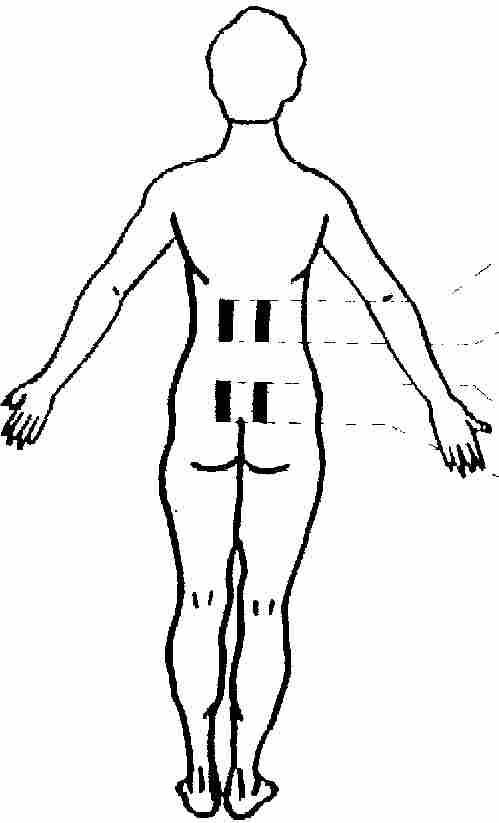
Diagram of TENS pads placement for labor
Comprehensive
page about the use of TENS for labor - Westons (in the
UK) also sells a variety of TENS units and accessories, including
the butterfly electrode pad.
Update
on nonpharmacologic approaches to relieve Labor pain and prevent
suffering
ARTICLE in JOURNAL OF MIDWIFERY AND WOMEN?S HEALTH ·
NOVEMBER 2004
co-author Penny Simkin
There's a short section on TENS use on pp. 15-17. And they include
a nice figure
showing the placement of the electrode pads.
The new MamaTENS is a
very attractive TENS unit; the design is more appealing and easier
to use than older types. The MamaTENS has a ramp-up feature
for faster generation of endorphins, when necessary. My only
complaint is that the electrodes aren't compatible with other
types, and I don't think they offer the butterfly electrodes,
which are functionally equivalent to the MamaTENS electrodes, but
just a little easier and more fun to use.
Babycare TENS (UK) and their sister company, Body Clock Health Care Ltd have been leading suppliers of TENS, EMS and Electro-acupuncture products in the USA, UK and Europe (including consumables such as electrodes, gels, batteries. etc).
They also sell A
women's guide to drug free pain relief before, during and after
birth
Maternity TENS (UK) -
Obstetric TENS Machines offer drug free pain relief that you can
use instead of or as well as 'Gas and Air' and'Pethidine'
TENS
in
Labor [from about.com]
TENS - Transcutaneous Electrical Nerve
Stimulation
TENS Reduces Pain During Hysteroscopy [Medscape registration is free.] - this is the most current study on the use of TENS for uterine-related pain. [Fertil Steril 2003;79:1422-1427.]
Int
J
Gynaecol Obstet. 1998 Mar;60(3):251-5.
Transcutaneous electrical nerve stimulation (TENS) for adjuvant
pain-relief during labor and delivery.
Kaplan B, Rabinerson D, Lurie S, Bar J, Krieser UR, Neri A.
CONCLUSIONS: TENS is an effective non-pharmacological, non-invasive adjuvant pain relief modality for use in labor and delivery. TENS application reduced the duration of the first stage of labor and the amount of analgesic drug administered. There were no adverse effects on mothers or newborns.
See also: Related
Studies
She placed the two pairs of pads diagonally in the area where the
pain was centrally located. One pair of pads was placed diagonally
across from each other, and then the other pair on the opposite
diagonal so that they make an "X". (If you have only one
pair of pads, she suggested just placing them on opposite sides
across the central location of the pain.)
TENS stands for Transcutaneous Electrical Nerve Stimulation. A TENS unit stimulates nerve endings, in effect, blocking the pain from traveling to your brain. Rather than contraction pain, most women feel a buzzing or a tingling sensation. It's like a continuous massage that releases more endorphins to help you manage your labor.
Why should you use a TENS? TENS is completely controlled by
the mother, giving you the ability to increase or decrease the
current according to your needs. TENS can provide a good
option for women who expect to be alone for part or most of
labor. TENS does not interfere with your ability to try
other comfort measures. The pads will need to be removed to
use the shower or tub, but they can be reapplied after your skin
is dry. TENS can provide pain relief at home, hospital, or
birth center. TENS can be invaluable for women during labor,
especially women experiencing painful back labor.
TENS is a method of applying controlled, low-voltage electrical
stimulation to large, myelinated peripheral nerve fibers via
cutaneous electrodes for the purpose of modulating stimulus
transmission and relieving pain. Research on TENS therapy in
patients with cancer
is limited to single-group studies and case reports (Avellanosa
and West, 1982; Bauer, 1983). A meta-analysis of studies of TENS
therapy in postoperative patients (Ballantyne, Chalmers,
Mosteller, et al., in press) found that both TENS and sham
TENS significantly reduced pain intensity; no significant
differences were found between the two for either analgesic use or
pain intensity. These results suggest that, just as with some
other interventions, part of the efficacy of TENS can be
attributed to a placebo effect. Patients with mild pain may
benefit from a trial of TENS.
I used a TENS for my first labour and have hired one for this
one. I would definitely recommend it. I didn't realise
how much it was working until I had to take it off for the
epidural for the c/s. One drawback is that you can't use any
water methods while you've got it on & you have to have it on
for a while before your natural endorphins build up.
TENS is more commonly used in the UK - the hospital had a few to
loan women in labour and I tried one when they started the gel
applications. It did help, I have to say. But by the
time labour *really* got going strong, I was so exhausted it
wasn't enough. Though, for some women I talked to there, it
was enough to help them through their labour. The key is to
start using it early on. Then you can gradually turn up the TENS
strength (the strength of the buzzing sensation it gives) as the
contractions get more and more intense. It is also important
that the four pads are placed on the right spots on the back so
the endorphins (sp?) are released.
[from ob-gyn-l]
I am seeking information about the use of a TENS unit for relief
of labor pain. I have been contacted by a nurse manager who, along
with the hospital CNM, would like to offer this as an alternative
method of pain relief in her facility.
I have had limited (3 cases) experience in using it in motivated
patients - they all decided it didn't work and two decided for
epidurals.
There is a recent review in the February issue of British Journal of Obstetrics and Gynaecology by Carroll, et al., "Transcutaneous electrical nerve stimulation in labour pain: a systematic review" This is a meta analysis of eight reports with a total of 712 women, 352 received TENS during labor and 360 acted as controls. The conclusion is that randomized controlled trials provide no compelling evidence for TENS having any analgesic effect during labor. Weak positive effect noted in some studies are probably due to design flaws in the studies. The exact reference is: Carroll, et al., Br. J. Ob. Gyn. 1997;104: 169-175. [An expanded abstract.]
LifeCare has both FreeLady and FreeMom.
tensaustralia.com
carries The
Freemom TENS unit
and they have great resources:
FreeMom Labor Electrode Placement Outline Part 1 Part
2 Part 7
FreeMom Usage for Labor Pain Management Part 3 Part 4
Part 8
FreeMom Use Prior to Induction Part 6
FreeMom Use to Alleviate "After-birth" Pain Part 5
FreeMom Use for Sleeping After the Delivery Part 5
FreeMom System Detail Part 11
Freemom Hire Application form
healiohealth.com
carries:
Soft-Touch Cloth Electrodes (PMT gel)-Butterfly 6”x 3.3 - 5
Packs for $16.75
Soft-Touch
Cloth Electrodes (tyco gel)Butterfly 6”x 3.3” - 5 Packs for
$19.00
Mettler Electronics carries the Com-Patch
4x6"
4x6" Butterfly Electrode at the best prices - $54 for
10 pads. 800-759-1288
They also have a very nice Electrode
Placement
Chart.
Here's a general search for butterfly electrodes for TENS units
These are old links to sources of butterfly electrodes, in case they start carrying them again in the future:
thebackrub.com carries the 3.3"
x
6" Dura-Soft Reusable TENS Butterfly Electrode Pads at very
good prices.
20 Electrodes for $82.95 (best value)
10 Electrodes for $52.95
5 Electrodes for $29.95
I've known an awful lot of pregnant women using TENS. Lots of
home units in my neck of the woods.. haven't heard of a slew of
them going into preemie labor...... but if it did stimulate the
uterus, wouldn't we see some kind of effect if it were used during
term labor?
I have rheumatoid Arthritis and use a TENS machine constantly for pain relief to my back.
I was using it for 9 weeks before I even realised I was pregnant. When I discovered I was pregnant I rang the SoM to ask her advice and she told me not to continue using it - but couldn't give me any reason so I researched a bit more. Both my GP and my MW told me it was ok to continue using the TENS and so I have throughout the pregnancy with no ill effects and it has obviously meant I have avoided taking pain killers (which in my mind would be far more risky)
Obviously mine is not a medical point of view and I guess it
differs for each person but I could find no evidence anywhere as
to why or how a TENS could interfere with a pregnancy.
Most maternity TENS machines will carry a warning saying "Do not use before 37 weeks" but there is no evidence to suggest that using them before this stage is harmful; it's just that they are designed for use in labour so haven't been tried before 37 weeks and manufacturers put this warning on to cover themselves.
A lot of holistic therapists will not treat pregnant women early on and their insurance may not cover them to treat pregnant women at this stage but this isn't because the treatment can be harmful but that miscarriage is quite common anyway and a woman who has miscarried may associate it with the treatment meaning that the therapist gets blamed or the woman blames herself and feels relay guilty about it.
A lot of the time its just that not enough research has been done on the product to prove that it's 100% safe; it doesn't mean it's dangerous.
When I was training in Sports Electrotherapy we were not told to avoid TENS in pregnancy, but you don't get many pregnant women coming for sports therapy!
I bought my first TENS machine years ago as a consumer because I
get a lot of back pain. It was a general one, not a
maternity one and they don't make this sort anymore but the only
thing it said was that it said it shouldn't be used over the
abdomen during pregnancy and was probably best avoided in the
first trimester if there was a history of miscarriage.
"Basically the sensation from the TENS over-rode the sensation from the contractions, so in the same way that an ongoing situation (say background music) is easier to sleep through than a stop-start situation (eg trains passing), it allowed me to rest without the interruption of each contraction."
I thought this was fascinating. I am continually looking for ways to help moms get some rest with prodromal labor, and this sounds promising. In reading through the little online literature about TENS, there were recurring suggestions that constant use of a TENS unit also raises endorphin levels, possibly having a similar effect to morphine for sleeping a mom.
This then gave me hope that it might also be used to break the cycle of inco-ordinate contractions the way morphine can.
Most of the literature is about using TENS during active labor.
Does anyone have any experience using TENS continuously as a way
of generating endorphins as an alternative to giving morphine?
From someone who has personal and professional experience with TENS.
Certainly feasible. The following is interesting:
"A commonly held theory for the mechanism of action of low-frequency TENS is activation of endogenous opioid pathways. Analgesia produced by low-frequency, high-intensity TENS but not high-frequency, low-intensity TENS is reversed by administration of naloxone, an opioid receptor antagonist (Sjolund & Eriksson, 1979). Similarly, high-frequency TENS is unaffected by systemic naloxone in patient populations (Abram, Reynolds, & Cusik, 1981; Freeman, Campbell, & Long, 1983). High-frequency TENS is therefore believed to work through mechanisms proposed by the gate theory, producing only short-term analgesia (Garrison & Foreman, 1994; Hollman, 1997)." [from The Basic Science Mechanisms of TENS and Clinical Implications by Kathleen A. Sluka, PhD PT from the MARCH/APRIL 2001 • VOLUME 11, NUMBER 2 bulletin of the American Pain Society. ]
A very good paper on the mechanism of action of Tens. Tens and
morphine both seem to act on the c fibres - this would be a
possible reason why the effect may be similar.
OK - I've ordered a British Obstetric TENS Unit - the TPN400 from Weston's. Basic instructions for setting the controls for labor:
The emWave
from HeartMath is an
excellent tool for practicing relaxation. It's nice to have
the visual and audio feedback!
The Self-Controlled
Energo
Neuro Adaptive Regulation (SCENAR) was developed for the
Russian space program to replace medical treatment for astronauts
during space travel.
See also: Aromatherapy
as a Relaxation Trigger
Effects of
music and essential oil inhalation on cardiac autonomic balance
in healthy individuals.
Peng SM, Koo M, Yu ZR.
J Altern Complement Med. 2009 Jan;15(1):53-7.
CONCLUSIONS: Listening to soft music and inhaling Citrus bergamia
essential oil was found to be an effective method of relaxation,
as indicated by a shift of the autonomic balance toward
parasympathetic activity in young healthy individuals.
When
Choirs Sing, Many Hearts Beat As One [7/10/13] - When
members of a choir sing, their heart rates quickly become
synchronized, beating in the same rhythm. Researchers think this
may be why singing together is a key part of religious rituals
around the world, and such a joy for the singers.
Music
structure determines heart rate variability of singers. [Free
full-text article]
Vickhoff B, Malmgren H, Aström R, Nyberg G, Ekström SR,
Engwall M, Snygg J, Nilsson M, Jörnsten R.
Front Psychol. 2013 Jul 9;4:334. doi: 10.3389/fpsyg.2013.00334.
eCollection 2013.
Choir singing is known to promote wellbeing. One reason for this may be that singing demands a slower than normal respiration, which may in turn affect heart activity. Coupling of heart rate variability (HRV) to respiration is called Respiratory sinus arrhythmia (RSA). This coupling has a subjective as well as a biologically soothing effect, and it is beneficial for cardiovascular function. RSA is seen to be more marked during slow-paced breathing and at lower respiration rates (0.1 Hz and below). In this study, we investigate how singing, which is a form of guided breathing, affects HRV and RSA. The study comprises a group of healthy 18 year olds of mixed gender. The subjects are asked to; (1) hum a single tone and breathe whenever they need to; (2) sing a hymn with free, unguided breathing; and (3) sing a slow mantra and breathe solely between phrases. Heart rate (HR) is measured continuously during the study. The study design makes it possible to compare above three levels of song structure. In a separate case study, we examine five individuals performing singing tasks (1-3). We collect data with more advanced equipment, simultaneously recording HR, respiration, skin conductance and finger temperature. We show how song structure, respiration and HR are connected. Unison singing of regular song structures makes the hearts of the singers accelerate and decelerate simultaneously. Implications concerning the effect on wellbeing and health are discussed as well as the question how this inner entrainment may affect perception and behavior.
Magic Home Birth - a Midwife's
Song by Judy Cohain. This song is available online, courtesy
of Judy.
6
Sounds Humans Love Most: Hydrotherapy, Snap, Crackle, Pop
(more invigorating), the sound of a campfire, laughter, white
noise, and the soothing sound of a comforting human voice!
Free MP3 Lullabies from Andy
Peyton [select Lullabies]
These are lovely lullabies you can carry with you to help soothe
yourself during pregnancy and to provide a calm atmosphere for
breastfeeding and soothing baby.
i love just about all of dean
evenson/soundings
of the planet cd's, and use them all the time in my practice
("peace through music" is their motto :) the music is very
relaxing and is absolutely non-invasive, and often includes an
"earth resonance frequency". until i found his recordings i
used to play no music at all during craniosacral sessions, now it
is on all the time and i have gotten lots of compliments.
some of my favs titles are "healing waters", "the tao of healing",
and "mountain meditation".
Nova Menco (flight ot paradise) for upbeat music that inspires
movement and makes time move quicker. Latin instrumental. I
always play this during class breaks when the class looks tired-
works well.
Ghazal (the rain) for more spiritual calmer music - eastern/
persian music, very instrumental but does have singing in persian-
have no idea what they are saying.
Slack Key Guitar- multiple composers- Hawaiin instrumental- calm
but good energy as well.
Gershwin- modern composer- classical.
Yo Yo Ma- Cello Suites- amazing instrumental.
Pure Moods II- an array of calm, upbeat, spiritual like music,
lots of artists.
I went to a birth once in which the couple was really into island
music- Hawaiian stuff like Israel "IZ" Kamakawiwo'ole, and mellow
reggae. It was the best labor music ever! So
lighthearted and relaxing, yet with a good beat to keep things
moving.
One of my clients asked me to be at the birth and hold space for her and to bring whatever music I read to vibrationally support an easeful birth and this was the list:
You might want to check out Lisa Gerrard, Dead can Dance,
Gabrielle Roth, Enya, Enigma, any music from Cirque du Soleil (I
like Verekai), and the angelic music of Libera for
soothing/calming. There is something about a tribal style that
brings out the primal strength in us, and Dead can Dance (terrible
name great music) did it for her as well as some of Gabrielle Roth
when it really got going. You can hear free samples on Pandora.com
and discover other similar tunes like them. I love that site.
Why Music Matters in Childbirth, by Taz Tagore. Music has a
central place in the lives of many of us, and it is an essential
part of some birth plans. The author discusses the research and
her experiences of music and birth, along with some helpful
suggestions. [from Midwifery
Today,
Spring, 2009, Article not available online.]
Start with the simple things . . . play uplifting music all day
long and all night long, too, if you're having trouble
sleeping. I have found that putting A Child's Gift of
Lullabyes on infinite repeat helps me to sleep easily and
soundly. It should be called A Midwife's Gift of
Lullabyes! The first song, Playing a Lullaby, is
the one that helps me most.
You can use the same principles as for aromatherapy to develop a
conditioned relaxation response to music - it's very POWERFUL!
Music Therapy in
Childbirth and Neonatal Care
Music To Set A Sacred Mood... RITUAL SONGS by the Colorado Midwives Association - NOW ON CD!!! from Mystical Evolution - oops! I think I read their listing wrong but I'm waiting for confirmation.
Acappella chants and songs performed by 4 members of the Colorado
Midwives Association (C.M.A.), designed for sing-along learning.
It contains material for gatherings (Blessingway, Rituals and
Birth), as well as private meditations to cleanse heal and
strengthen. Selections include Woman I Am, I Am the Circle, Mother
Moon, We Are Sisters, as well as more traditional images such as
May the Blessings of God Rest Upon You and We All Come From God.
Simple and lovely; we've been getting requests for this
"underground classic," and are glad to be able to make it
available; proceeds benefit the non-profit C.M.A., dedicated to
providing better birth experiences through homebirth services.
Cassette: 9.98
Sounds of Life
is a collection of 40 original recordings with over 3 hours of
music. This unique 3 Disc set of beautiful and soothing
compositions was created to help a woman relax through her
birthing experience.
Passion - Intimate
Piano Music - although this is from a site about female
sexual arousal (the "G-crest", "G-spot" or female ejaculation),
this CD is excellent for facilitating the relaxed and sentimental
mood that is conducive to the relaxation of the uterine muscles
that hold the cervix shut, i.e. the muscles activated by
adrenaline.
Great Mother is by Shawndeya (Atmospheric Alchemy P.O. Box 70662,
Eugene, OR 97401) and the Silent Path is by Robert Haig Coxon (RHC
Productions, Inc. P.O. Box 4172 Westmount, Quebec, Canada
H3Z3B6). They are both wonderful!
"Music
To
Be Born By" by Mickey Hart, Rykodisc, Pickering Wharf Bldg
#C-3G, Salem, MA 01970
Midwives June Whitson and Roxanne Potter have produced the
cassette tape Waiting for a Child: Songs, Relaxation and
Visualization for Childbirth. Created with musicians, Barry and
Shelley Phillips the tape features cello, tabla, Celtic harp, and
oboe. Copies are available at 150 Via Venito, Corralitos, Santa
Cruz, CA 95076. $10 each plus $2.50 shippint for 1 or 2
cassettes.
I really like Canyon Trilogy by R. Carlos Nakai, it is Native
American flute music and I've gotten lots of compliments on it
from both clients and hospital staff.
I liked Mozart for Mothers to be.
A good CD to use for relaxation is "Pure Moods" .
My favorite is Steve Halpern's Spectrum
Suite for use in classes. It never fails to relax couples
and they often find they want to use it during their births. Since
it is such an individual choice, I usually tell couples to
experiment, bring various tapes to class to try. The thought of
classical will drive some crazy, country music will make others
nuts. [Steven Halpern is one of the few who pays attention
to the theory of music and relaxation - its worth a visit to his web site.]
Some of my favorites now:
One of my (and the birth center's) favorite is a virtually unknown cd by a woman named Molly Canole who delivered at Special Beginnings (where I worked) and finished the cd the day before her labor began. Probably the most touching birth ever for me, Molly sang along with the cd as soon as her daughter was born, not only making the husband cry, but also the experienced Doulas and CNM. Molly's music has already won several awards and certainly deserves a listen. It is called Beautiful Dreamer and is classic lullabies sung in her angel soprano voce. And, btw, the pic of Molly and her babe on the cover is the first picture her hubby took of the two of them, right in the bed at the birth center when the baby was a minute old! (and SB gets no proceeds, nor do I... just sharing something I think y'all would enjoy :) )
For early labors, or to change the mood from somber to lighthearted, I use Maire Brennan (who is Enya's sister).
For raucous families... and my Hispanic clients in early labor
(who totally love it!)... I play Gypsy Kings (wondrous mariachi
music and vocals in Spanish)
My favorites for relaxation are: "When you Wish Upon a Star" by Daniel Kobialka (available from Li-Sem Enterprises, Inc., Belmont, CA); "Harp of the Healing Waters" by Erik Berglund (Available from Helios Music, 800-900-5997); and "The Healing Waterfall II" by Max Highstein with Jill Andre (Available from Serenity, 800-869-1684). "The Healing Waterfall II" has a beautiful 20 minute guided imagery that is superb for practicing relaxation in class or at home.
My favorites for second stage are: "Vangelis Chariots of Fire"
(taken from the original soundtrack (Available from PolyGram
Records) and "Hallelujah" from Handel's "Messiah" performed by the
Mormon Tabernacle Choir. For first stage labor, I encourage
mothers to use the music that helps them to best relax.
This section is written more from the point of view about how making noises feels good to the laboring woman.
See also: Birthing
Noises
See also: Prenatal
Music and Audio Bonding - Womb Song - Lullabyes
It can be very helpful to practice your breathing techniques or
listen to guided imagery/relaxation/hypnosis tapes while playing a
particular music album in the background. Then your body
comes to associate that music with deep relaxation, so when you
play it during labor, your body automatically relaxes.
Simple but very effective.
I like your mention of the lower chakras. have found this an
especially helpful approach as well. I teach the use of the sounds
of the chakras when birthing and breastfeeding. Oooooh to open the
cervix, oh to build energy if mom is getting exhausted and Ahhhto
help the milk flow. These sounds will actually happen naturally if
you just watch an uninterfered with birth and postpartum period.
There was a book of birth stories written by Catherine Milinaire
in the 1970s called "Birth" (1974), and one of the stories was of
a woman who sang her way through labor in a busy urban
hospital. It left a powerful image in my mind. But
what I remember about singing is being coached to whistle or sing
so as not to push with my second baby - because "the doctor isn't
here yet" - and how crappy I felt hyperventilating while trying to
obey orders.
My neighbor told me about singing in labor, that it really helped
her more than any breathing style. So while having the rest of my
kids I sang in labor much simpler than talking about breathing,
the breathing for singing is automatic. I've encouraged some of
our birthing gals to sing ,nursery rhymes, Beatles, country songs
what have you.
We used to teach this in childbirth classes. Works well for
many moms
I had a client many years ago who is a minister and from what I
have been told, sings many of her sermons. When she was in
labor, she sang. Her voice was beautiful. As
transition neared, her words became much more deliberate as she
sang, "Soon now very soon, we're going to see the king...."
It was lovely.
One of my friends sang "Swing Low", "The Impossible Dream", and
"Climb Every Mountain" On the way to the hospital we picked
up a young soldier Hitchhiking and he thought we (a bunch of
freaks who had become religious) were just rolling along
Partying. When he asked where we were going three in the
morning and we told him the singer was having a baby he was
incredulous. Hoped he remembered the scene when it was his
time to become a father. Also afterwards all the other women
who were birthing at the same time, told my friend how her singing
had given them courage and serenity to get through their
births. Very nice.
Years ago I used to rent a movie called hypnosis as sole
anesthesia for C-Sec. The woman they filmed sang
through the section.
I found a very comfortable position when having back labor is
standing and rocking from side to side and also stand and doing
little squats. It really helps to ease the pain.
Electrolyte water with calcium - sometimes called a sports drink.
Our local stores carry Miracle Water, which is terrific and
unflavored, so you can use it to mix up fruit juices, soups, etc.
Cold gel packs (in the freezer).
Inexpensive bamboo fan for helping to keep the mom's face cool
when she needs it.
If it's hot weather, I like to have a square yard of light
material that you can dampen and then lay gently over the mom's
shoulders. It's not as heavy as a towel or most table linens and
really cools her down fast. (Many homes have a supply of fabrics
which would be suitable if this were needed.) Also, it's nice to
have a spray bottle or plant mister to spray around her face,
neck, shoulders.
Diaper wipes, for any sorts of smudges of whatever that you might
not want to use a washcloth for. You might have these around for
the baby, anyway, but it's nice to have them out and open and next
to the box of Kleenex.
They're terrific. I once labor coached for a homebirth where the mom was willing to go for walks outside but was concerned about the leaking. "No problem," the midwife said, "get some Depends." (By the way, for those who don't know, Depends are incontinence undergarments.) The woman's eager partner was back in a jiffy with some Depends, and off we went. It turns out you can even pee a substantial amount in these and they REALLY do not leak. This particular woman loved them. I think we went through several packs during her labor. Most women don't need that many.
Details: My favorite kind are the ones that look like big sanitary napkins, rather than the ones that look like "regular" underwear, i.e. briefs. They are held on by elastic straps around the waist and leave the legs free for walking and lots of different positions. Our local drug store was carrying some sample packs for less than a dollar. They contained two Depends and the all-important elastic straps, which normally come only two sets to a pack of 16 Depends, which makes it difficult to share the pack over a number of different births unless you happen to remember to reclaim the elastic straps and wash them.
Alternatively, those new "Personals" disposable underwear are pretty cool and very useful also, although they don't accommodate a pregnant belly quite so well. However, they are terrific for postpartum. If they fit, they also can be used during labor, especially with one or two maternity sanitary napkins tucked inside.
It bothers me that hospitals don't provide a way for leaking
women to feel comfortable about being up and about. In a pinch,
you can improvise with a disposable baby's diaper inside regular
underwear, although I don't think this would be that comfortable.
See also: Medical
Marijuana for Nausea
This information is included here in the hope that medical researchers might investigate the medical use of marijuana during labor and birth as a safer alternative to the harder narcotics that are used in IVs and epidurals.
Of course, there are many other non-pharmaceutical labor aids: hypnosis, homeopathics, herbs, essential oils, chiropractics, affirmations, flower essences, etc.
This information is in no way meant to encourage the use of
illegal substances.
As with many controversial subjects, it is hard to get good
objective research on this subject, but I'm inclined to agree with
those who assert that the relaxing influence of cannabis allows
the body to function as designed, even in a high-stress hospital
environment.
Does anyone know of any harm that can come to the baby if this is
used as a form of pain relief?
Cannabis is a herb, and a safe one at that, of course, not every woman is going to want or need its help but for those who need some assistance coping with the pain, fatigue, nausea and even depression that can accompany birth and pregnancy, you would do well to consider Cannabis. I found Cannabis tincture wonderful during that chaotic phase they call transition, it doesn't kill the pain or disassociate you from the experience, it just softens the intensity enough to make the whole experience more enjoyable.
Here's some information regarding use of Cannabis during labor:
Cannabis as Medicine, (Part 3 of 4) by Gary Stimeling- search for "An Aid in Menstruation and Childbirth"
Pain Management - A Practical Guide for Clinicians - search for "Birth"
History Of Marijuana, Medical Use (Part I) - search for "Birth"
From: http://www.utopiasprings.com/vcancirc.htm
..."The safety during pregnancy seems quite good when used in
moderation, and teas may be best route to achieve long lasting
medical, psychological and nutritional effects. It use
during childbirth is controversial as its interaction with
surgical drugs may occur during C-Section and other proceedures.
Some light smoking during childbirth may be indicated for pain and
anxiety. Cannabis during nursing may increase milk but since it
is fat soluable it is also transmitted in milk, which as not
been shown to be dangerous, and may be beneficial."
Not so sure that it's use may be beneficial when breastfeeding
though!
We have a bit of an issue with women using cannabis during labour here. The babies are often born too stoned to be bothered breathing and they can't be bothered trying to latch on to feed (guess they don't get the munchies).
I really wouldn't advise it during labour.
I also would be very wary of a site called utopiasprings that purports safety of cannabis, ummmm can you say possible bias!
We know that cannabis is implicated in drug-induced psychosis and
a higher level of schizophrenia amongst teenage users...I don't
think its a good idea to introduce it to a not yet born person!
I am about to deliver my seventh baby and used cannabis for pain and stress relief with all my pregnancies and births. My children were alert and all latched on to the breast easily. My labours were all uncomplicated and I did not get unduly stressed or anxious, this I attribute in great part to my use of Cannabis. Cannabis is a muscle relaxant, it is antibiotic, anti-inflammatory and is a very affective yet gentle and safe analgesic when used in correct dosage and with awareness and right information. I find the claims that babies "were too stoned to suckle and breathe " VERY difficult to believe. If that were the case us Rastas would be dying out but instead we are on the increase!
Check the Indians use of Cannabis in their very ancient system of medicine -Ayurveda, this should alleviate some of the hysteria and superstition regarding this most awesome and safe medicinal herb. Comparing the safety factor of using cannabis with pethidine for pain management during birthing, there is no doubt in my mind which "drug" leaves us and our babies more alert and healthier.
Research (Costa Rican report, early 80's) show that Cannabis babies (breastfed by smoking mothers) were in general MORE alert, responsive and outgoing than their non herbalized counterparts, and grew up with higher IQ's and were more lateral thinkers.
Please contemplate this with an open mind and do more research
before you perpetuate negative propaganda, use of this herb helps
liberates us from dependence on a system that is in crisis and
relies on people that distrust the inherent wisdom, goodness and
capable powerfulness that we are.
Natural redheads have a higher pain threshold than others, says
geneticist Jeffery Mogil of McGill University's pain
laboratory. Men and women with naturally red hair can
withstand 25 percent more electric shock than non-redheads.
And painkillers used in chidbirth work three times better on
red-haired women than on others. Mogil and his team
found that the mutant gene that causes red hair, melanocortin -1
(MC1R), also affects how redheads (including mice) react to
pain. Now geneticist Ian Jackson of the United Kingdom
Medical Research Council plans to study redheads in the hope of
developing new painkillers. Connecting the gene to pain was
surprising and exciting, Jackson says. "We thought that MC1R
was involved only in hair color."
Melanocortin-1
receptor
gene variants affect pain and mu-opioid analgesia in mice and
humans.
Mogil JS, Ritchie J, Smith SB, Strasburg K, Kaplan L, Wallace MR,
Romberg RR, Bijl H, Sarton EY, Fillingim RB, Dahan A.
J Med Genet. 2005 Jul;42(7):583-7.